Beryl Garcia
The Hound of the BaskervillesBeryl Garcia is Stapleton’s wife, although he presents her to the people around them as his sister. Her concealed identity turns Sir Henry Baskerville’s courtship into part of Stapleton’s deception; her repeated attempts to warn Sir Henry and her eventual cooperation with Sherlock Holmes help expose the danger and locate Stapleton after he flees. Beryl’s story is therefore not merely a revelation about a false family relationship: it traces how a woman constrained by her husband’s influence becomes an indispensable witness against him.
Identity and Concealment
For much of the investigation, Beryl is known as Miss Stapleton and understood to be Stapleton’s sister. Sherlock Holmes eventually tells Dr. Watson that this relationship is false: she is Stapleton’s wife. The difference changes the meaning of earlier encounters. What appeared to be a brother’s protective concern for his sister’s romantic future was, in fact, the conduct of a husband concealing their marriage while managing the approaches of a prospective victim.
Holmes substantiates the identification with documentary evidence rather than assertion. He produces a photograph taken in York four years earlier, labelled as showing Mr. and Mrs. Vandeleur, alongside three descriptions by witnesses who knew the couple when they kept St. Oliver’s private school. Beryl recognizes the evidence and confirms that Stapleton had offered her marriage on condition that she could obtain a divorce from her husband. She concludes that he had lied to her and used her as a tool. The photograph and witness accounts connect her present identity to the couple’s earlier life, making the false siblinghood part of a broader pattern of concealment.
The Courtship and Its Reversal
Sir Henry Baskerville becomes attached to Beryl, but Stapleton initially blocks the relationship. His explanation, as reported by Sir Henry, is that his sister is the centre of his life: they have been companions, he has felt lonely, and the prospect of losing her overwhelmed him. He apologizes for his behaviour and says that he would rather she married a neighbour such as Sir Henry than anyone else, but asks for three months in which Sir Henry will seek only her friendship. Sir Henry accepts these terms.
That explanation gives the apparent brother-sister bond an emotional plausibility, while obscuring its real basis. Holmes later explains that Sir Henry’s attraction could not harm anyone but Sir Henry, and that Stapleton took care to prevent him from making love to Beryl. At the same time, Stapleton encouraged an intimacy that would bring Sir Henry repeatedly to Merripit House and eventually create an opportunity for his plan. His jealousy nevertheless broke through his controlled manner when Sir Henry paid Beryl attention. The courtship thus becomes both a managed element of the plot and a strain that reveals the possessiveness beneath Stapleton’s disguise.
Resistance and Disclosure
Beryl is not a willing partner in every part of Stapleton’s scheme. Holmes’s later account distinguishes her compliance with the false identity from her refusal to become a direct accessory to murder. Under Stapleton’s influence, which Holmes considers might have involved love, fear, or both, she passes as his sister. Yet she tries repeatedly to warn Sir Henry, doing what she can without exposing her husband. Her position is precarious: she possesses knowledge of the danger, but acting openly would also implicate the man whose power over her remains effective.
The crisis changes her allegiance. On the evening Sir Henry is expected at Merripit House, Beryl has learned of the convict’s death and knows that Stapleton’s hound is being kept in the outhouse. She confronts Stapleton about the intended crime. The confrontation ends with him preventing her from warning Sir Henry, and she is held in a locked room while he prepares to flee. Her earlier warnings had been limited by secrecy; now Stapleton’s effort to silence her makes the danger plain and leaves her unable to intervene herself.
Rescue and the Route to Stapleton
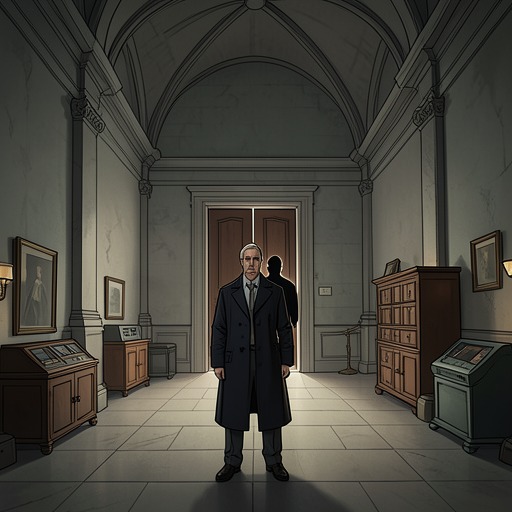
Sherlock Holmes, Dr. Watson, and Inspector Lestrade find Beryl bound and exhausted in a room fitted out as a small museum, its cases filled with Stapleton’s butterfly and moth collection. They free her and help her recover. Once able to speak, she identifies the place where Stapleton is most likely to have gone: an old tin mine on an island in Grimpen Mire. She says that he kept the hound there and had prepared a refuge. Her knowledge turns the search from speculation into a specific lead, linking the animal’s concealment to Stapleton’s intended escape route.
Beryl’s account also helps explain how Stapleton expected to manage the consequences of his hidden identity if he entered the succession. She had heard him consider claiming the property from South America after establishing his identity with British authorities there, using a disguise during a brief visit to London, or supplying an accomplice with proof and papers so that the accomplice could claim the inheritance while he retained a share of the income. These possibilities reveal the practical problem his fraud had to solve: a man living near the estate under another name could not straightforwardly appear as its heir without inviting scrutiny.
Narrative Role and Outcome
Beryl’s testimony completes a chain of evidence that physical proof alone cannot provide. The photograph and witness descriptions establish who she and Stapleton had been; her account of his marriage offer and her knowledge of his plans expose the private deceptions behind his public identity. Her information about the mine, meanwhile, supplies a concrete direction after he escapes. She is at once the person most closely entangled in the disguise and a witness whose eventual refusal to protect him helps unravel it.
Her ending is a rescue, not a reconciliation. She describes having been deceived and used, and Holmes’s reconstruction presents her change of allegiance as a response to Stapleton’s threatened murder of Sir Henry and his attempt to silence her. Stapleton’s fate remains connected to the dangerous mire to which she directs the investigators; the account does not report a reunion or a further life for Beryl. Her decisive contribution is instead to turn withheld knowledge into evidence and actionable intelligence, making the concealed wife central to the exposure of the concealed heir.